What Environmental Education Means in Practice
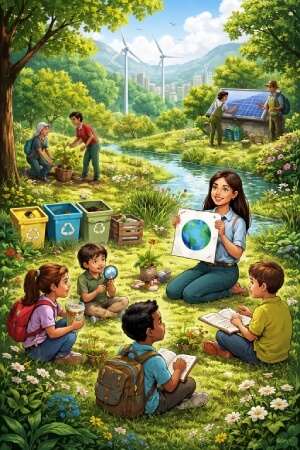
Environmental education is a structured way of learning about natural systems, human influence on the environment, and the consequences of everyday decisions. It is not limited to classrooms or age groups. Instead, it spans schools, universities, community programs, workplaces, and public campaigns, adapting its depth and focus to different audiences.
Core Principles Behind Environmental Education
Most environmental education frameworks share a few common principles. These include scientific accuracy, balanced perspectives, and respect for local and cultural contexts. Learners are encouraged to question sources, examine evidence, and understand uncertainty, especially where environmental data is complex or evolving.
Another key principle is relevance. Lessons are often linked to familiar surroundings, such as local water systems, nearby green spaces, or regional weather patterns. This helps learners connect abstract concepts to everyday life, making the information more meaningful and easier to retain.
Who Environmental Education Is For
Environmental education is designed for all age groups, though the methods vary. In early education, it often focuses on observation, curiosity, and simple cause-and-effect relationships. At higher levels, it may involve data analysis, policy discussion, and ethical considerations related to development and conservation.
Outside formal education, adults encounter environmental learning through public information campaigns, workplace training, and community initiatives. These settings often emphasize practical decisions, such as waste reduction, energy use, or land management, rather than theoretical knowledge alone.
Common Learning Approaches Used Worldwide
Environmental education does not rely on a single teaching model. Instead, it uses a range of approaches that reflect different educational traditions, resources, and environmental priorities across regions. These methods are often combined to suit local needs and learning goals.
Classroom-Based Learning
Traditional classroom learning remains a foundation of environmental education, particularly in schools and universities. Lessons may cover topics such as climate systems, biodiversity, pollution pathways, and resource management, often supported by textbooks, visual materials, and structured assessments.
In many systems, environmental topics are integrated into science, geography, or social studies rather than taught as a separate subject. This approach highlights how environmental issues intersect with economics, health, and social development.
Outdoor and Experiential Learning
Learning outside the classroom is widely used to reinforce environmental concepts. Field trips, nature observation, and hands-on projects allow learners to see ecosystems and environmental processes directly. These experiences help translate theory into observable reality.
Outdoor learning is especially effective for topics like habitats, water cycles, and soil health. It also encourages attention to detail and long-term observation, which are important skills for understanding environmental change over time.
Community and Project-Based Approaches
Many environmental education programs involve community projects, such as local clean-ups, tree planting, or monitoring wildlife. These activities connect learning with shared responsibility and collective outcomes.
Project-based learning often includes planning, data collection, and reflection. This helps participants understand not only what actions are taken, but why they matter and what their limitations may be.
Digital and Informal Learning
Digital platforms have expanded access to environmental education through online courses, documentaries, interactive tools, and open data sources. Informal learning also occurs through museums, public exhibitions, and media coverage of environmental topics.
These formats allow learners to explore issues at their own pace and follow personal interests, though they also require strong critical skills to assess information quality and bias.
Environmental Protection
Environmental protection refers to efforts aimed at reducing harm to natural systems and maintaining conditions that support life. It covers a wide range of activities and policies, from pollution control to habitat conservation, and operates at local, national, and global levels.
Rather than focusing on advocacy, a neutral explanation looks at what environmental protection involves in practical terms. This includes understanding the types of environmental pressures that exist and the basic tools used to manage them.
Types of Environmental Pollution
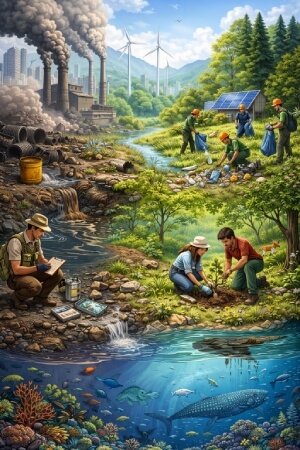
Pollution occurs when substances or energy are introduced into the environment at levels that cause harm. Common categories include air pollution from emissions, water pollution from industrial or agricultural runoff, and soil contamination from waste and chemicals.
Ecosystems and How They Function
An ecosystem is a network of living organisms interacting with their physical environment. Forests, wetlands, oceans, and urban green spaces are all examples of ecosystems, each with distinct structures and processes.
Healthy ecosystems tend to regulate themselves through balances between species, nutrients, and energy flows. Disruptions, whether natural or human-driven, can alter these balances, sometimes gradually and sometimes abruptly.
Conservation Basics
Conservation focuses on maintaining ecosystems, species, and natural resources over time. This can involve protecting habitats, managing resource use, or restoring damaged environments.
Conservation strategies vary widely depending on context. Some prioritize strict protection, while others emphasize sustainable use. Environmental education helps explain these differences and the trade-offs involved, rather than presenting conservation as a single fixed model.
Key Areas Commonly Covered in Environmental Education
Environmental education often brings together multiple themes to give learners a broad foundation. While programs differ, several topics appear consistently across regions and age groups.
- Natural resource use and limits
- Human impact on land, water, and air
- Biodiversity and species interaction
- Waste generation and management
- Environmental decision-making and responsibility
Learning to See the Bigger Picture
It is not really about learning but about changing perspective. Thanks to it, students can form the basis for understanding how natural systems interact, how human activity affects those systems, and why such relationships are important in time. The environment education can guide one to make choices without opting for a prescribed path, by applying scientific knowledge with some principles of experiential learning. Being able to see relationships clearly is one of the most valuable skills that can be learned from education in this world imprinted deeply in environmental change.
Our environmental education work continues to drive meaningful change, equipping every child with the knowledge to safeguard the earth and mitigate the impacts of climate change pic.twitter.com/P0jnJro0R3
— Anish Ahamad (@anishahamadENV) January 9, 2026
With the kind support: